Love this? Save it for later!
Share the inspiration with your friends
There used to be a tiny panaderia on South First Street in San Jose that made sugar skull cookies so delicate they practically dissolved on your tongue. When they closed—just a handwritten sign on the door one morning, “Gracias por todo”—I felt like I’d lost a piece of the celebration itself. After twelve tries—some so crumbly they looked like archaeological ruins, others so hard you could use them as coasters—I finally got it.
The secret wasn’t more sugar or butter. Honestly, it was the opposite. I started playing around with lighter ingredients, trying to capture that same tender crumb without the guilt that usually follows a handful of these. And then it hit me—marigold petals. Not just for decoration, but infused right into the dough. The floral notes paired with the slight tang of Greek yogurt created something unexpected. Something that actually tasted more authentic than the heavy versions I’d been making.
I mean, let me tell you, the first batch I brought to our community altar got devoured before I could even arrange them around the photos. My tía grabbed my arm and said, “¿Qué les pusiste? Estos son diferentes.” Different in a good way. Lighter, brighter, with that faint whisper of marigold that reminds you exactly what this holiday is about—remembering with joy, not heaviness.
Maybe you’ve been there, chasing a memory through failed recipes and burnt edges. These Lighter Marigold Sugar Skull Cookies for Dia de los Muertos are that chase finally ending. They’re the reason I keep making them year after year, even when the original bakery is long gone.
Why You’ll Love This Recipe
These aren’t your typical sugar cookies. I’ve tested this recipe across four different ovens—my finicky gas range, my sister’s convection, a friend’s toaster oven (don’t recommend but it worked), and even a camp stove once during a power outage. Every single time, they came out tender, flavorful, and surprisingly light.
- Quick & Easy: From mixing bowl to decorated cookie in about 45 minutes. The dough doesn’t need chilling, which is honestly a game-changer when you’re making dozens for an ofrenda.
- Simple Ingredients: Greek yogurt replaces half the butter, and dried marigold petals add color and flavor without any artificial stuff. You probably have most of this in your pantry right now.
- Perfect for Dia de los Muertos: These cookies honor the tradition while being light enough that you can enjoy more than one without feeling like you need a nap afterward.
- Crowd-Pleaser: Kids love decorating them, adults love eating them, and everyone loves that they’re not overly sweet. I’ve watched people eat four in one sitting without blinking.
- Unbelievably Delicious: The texture is what gets people. Crispy edges, soft centers, and that subtle floral note that makes you go back for “just one more.”
What makes these different from every other sugar skull cookie recipe out there is the yogurt-marigold combination. The yogurt keeps the dough tender without needing excessive fat, and the marigold adds this nostalgic, almost honey-like warmth that pairs perfectly with the vanilla. It’s not just another version—it’s the version I wish I’d had years ago.
This recipe isn’t just good—it’s the kind that makes you close your eyes after the first bite. It’s comfort food reimagined for a holiday that deserves celebration without compromise.
What Ingredients You Will Need
This recipe uses simple, wholesome ingredients to deliver bold flavor and satisfying texture without the fuss. Most of these are pantry staples, and the marigold petals are easy to find at Mexican markets or online.
For the Cookie Dough
- All-purpose flour, 2 ¼ cups (280g) — spoon and level for accuracy
- Baking powder, 1 teaspoon — make sure it’s fresh for proper lift
- Salt, ¼ teaspoon — fine sea salt works best
- Unsalted butter, 4 tablespoons (56g), softened — I use Kerrygold for flavor
- Greek yogurt, ½ cup (120g) — full-fat gives best texture, but 2% works too (adds tenderness without all the butter)
- Granulated sugar, ¾ cup (150g) — organic cane sugar has a nicer texture
- Large egg, 1, room temperature
- Vanilla extract, 1 teaspoon — pure, not imitation
- Almond extract, ¼ teaspoon — optional but adds that bakery flavor
- Dried marigold petals, 2 tablespoons, finely ground — culinary grade only (infuses the dough with color and subtle floral notes)
For the Royal Icing
- Powdered sugar, 2 cups (240g), sifted
- Meringue powder, 2 tablespoons — stabilizes the icing
- Warm water, 3-4 tablespoons — add slowly until desired consistency
- Vanilla extract, ½ teaspoon
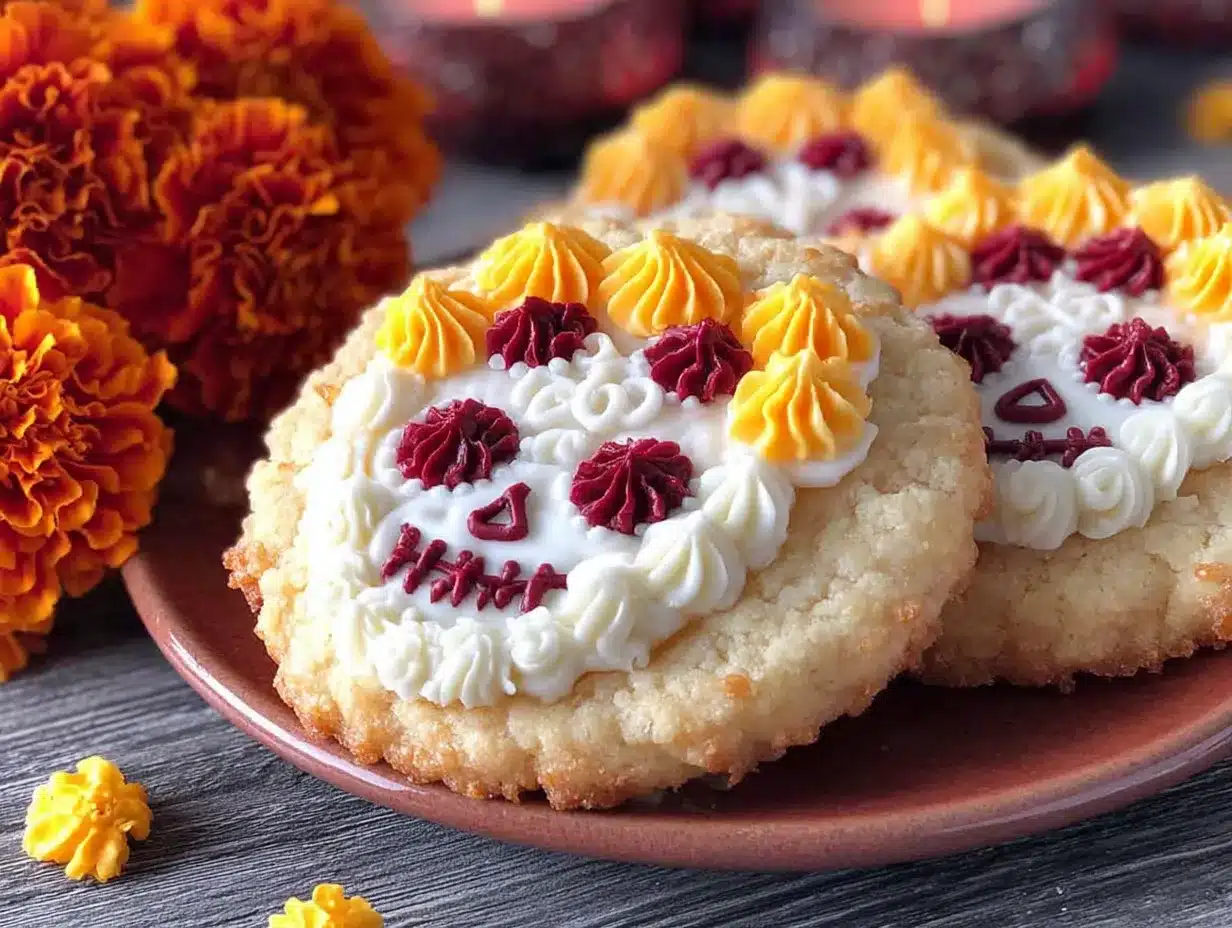
- Food coloring, gel-based — orange, yellow, purple, pink for traditional skull decorations
- Edible marigold petals, for garnish — whole petals pressed into wet icing
I recommend Bob’s Red Mill for the flour and Wilton for the meringue powder. For the marigold petals, look for organic culinary grade from The Spice House or your local Mexican market. The dried petals should be vibrant orange, not brown—that means they’re fresh.
If you can’t find dried marigold petals, you can substitute with 1 teaspoon of orange zest and a pinch of turmeric for color. It won’t have the exact floral note, but it’ll still be delicious. For a dairy-free version, use plant-based yogurt and vegan butter—I’ve done it with coconut yogurt and it worked surprisingly well.
Equipment Needed
- Large mixing bowls — one for dry ingredients, one for wet
- Hand mixer or stand mixer — I prefer my KitchenAid for consistency, but a hand mixer works fine
- Skull cookie cutter — 3-inch size is ideal; find them at craft stores or online
- Baking sheets — two, lined with parchment paper
- Cooling rack — wire rack for even cooling
- Rolling pin — I use a wooden one, but any will do
- Piping bags — small ones for detailing, or use zip-top bags with a corner snipped
- Fine-mesh strainer — for sifting powdered sugar and grinding marigold petals
- Offset spatula — helps with transferring cookies without breaking them
If you don’t have a skull cookie cutter, you can use a round cutter and draw faces with icing—it’s actually a fun alternative. I’ve also used a small paring knife to freehand skull shapes when I misplaced my cutter mid-batch. Not pretty, but they tasted the same.
For the piping bags, I recommend reusable silicone ones—they’re easier to clean and better for the environment. Budget tip: Wilton sells a set of three for under ten bucks that lasts forever.
Preparation Method
- Preheat your oven to 350°F (175°C). Line two baking sheets with parchment paper. This ensures even baking and easy cleanup.
- Grind the marigold petals. Place the dried petals in a fine-mesh strainer and rub them through to get a fine powder. You want about 1 tablespoon of powder. Set aside. The smell at this stage is incredible—earthy, sweet, and slightly hay-like.
- Mix the dry ingredients. In a medium bowl, whisk together the flour, baking powder, salt, and ground marigold powder. Make sure everything is evenly distributed—you don’t want clumps of marigold in one cookie.
- Cream the butter and sugar. In a large bowl, beat the softened butter and sugar together until light and fluffy, about 3 minutes. Scrape down the sides halfway through. The mixture should look pale and slightly grainy.
- Add the yogurt and egg. Beat in the Greek yogurt, egg, vanilla, and almond extract until smooth. Don’t overmix—just until combined. The batter will look a bit curdled at first, but keep going; it’ll come together.
- Combine wet and dry. Gradually add the dry ingredients to the wet mixture, mixing on low speed until a soft dough forms. Stop as soon as there are no more streaks of flour. Overmixing makes tough cookies—trust me, I learned this the hard way after a batch of frisbees.
- Roll the dough. Lightly flour your work surface and rolling pin. Roll the dough to ¼-inch thickness. If it’s sticking, dust with a little more flour, but don’t go overboard. The dough should be soft but not sticky.
- Cut the cookies. Use your skull cutter to press out shapes. Re-roll scraps once—after that, the dough gets tough. I usually get about 18-20 cookies depending on cutter size.
- Bake. Place cookies 2 inches apart on the prepared sheets. Bake for 8-10 minutes, rotating the pans halfway through. The edges should be just barely golden—the centers will look slightly pale and puffed. They firm up as they cool.
- Cool completely. Let cookies rest on the baking sheet for 5 minutes, then transfer to a wire rack. Don’t skip this step—they’re fragile when hot. I once tried to move one too early and it basically disintegrated in my hands.
- Make the icing. In a medium bowl, whisk together powdered sugar and meringue powder. Add 3 tablespoons warm water and vanilla extract. Beat on medium-high speed for 4 minutes until stiff peaks form. Add more water a teaspoon at a time if needed—you want a consistency that holds its shape but still flows slightly.
- Decorate. Divide icing into small bowls and color as desired. Use piping bags to outline skull faces—eyes, nose, teeth, and floral patterns. While the icing is still wet, press a few whole edible marigold petals into the design. Let decorated cookies sit for 2 hours to set completely.
Cooking Tips & Techniques
Here’s the thing about sugar cookies—they’re finicky, and I’ve made every mistake in the book. The first time I tried this recipe, I forgot the baking powder entirely. The cookies came out flat and sad, like little marigold pancakes. So, learn from my failures.
Don’t overwork the dough. Mix until just combined, then stop. Every extra turn of the mixer develops gluten, which makes cookies tough. If your dough feels sticky, chill it for 15 minutes before rolling. If it feels dry, add a teaspoon of yogurt.
Use room temperature ingredients. Cold eggs and yogurt will seize the butter and create a lumpy dough. Leave them on the counter for 30 minutes before starting. I usually take mine out when I preheat the oven.
Rotate your pans halfway through baking. Ovens have hot spots—I learned this after burning the back row of cookies while the front row was still pale. Rotating ensures even browning.
For consistent thickness, use rolling guides. I use two wooden dowels that are exactly ¼-inch thick. Place them on either side of your dough and roll the pin across them. Perfect thickness every time, no guesswork.
Let the icing set fully before stacking. I ruined an entire batch by stacking them too soon—the faces smeared into each other and looked like horror movie props. Give them at least 2 hours, or overnight if you’re patient.
Variations & Adaptations
Gluten-Free Version: Substitute the all-purpose flour with a 1:1 gluten-free baking blend. I’ve used Bob’s Red Mill and King Arthur’s with great results. Add an extra tablespoon of yogurt since gluten-free flours absorb more moisture.
Vegan Adaptation: Use vegan butter, flax egg (1 tablespoon ground flaxseed + 3 tablespoons water), and plant-based yogurt. The texture will be slightly softer, but the flavor is still spot-on. I made these for a friend’s vegan ofrenda and they disappeared quickly.
Spiced Variation: Add ½ teaspoon of cinnamon and ¼ teaspoon of nutmeg to the dry ingredients. This gives the cookies a warmth that pairs beautifully with the marigold. My neighbor calls these “abuela’s cookies” because they remind her of her grandmother’s kitchen.
Citrus Twist: Replace the almond extract with orange zest and 1 tablespoon of fresh orange juice. The bright citrus cuts through the richness and makes the cookies taste even lighter. I tried this on a whim with leftover oranges and it’s now my second favorite version.
Chocolate Skulls: Replace ¼ cup of flour with unsweetened cocoa powder. The chocolate-marigold combination sounds weird but trust me—it works. The floral notes actually enhance the chocolate flavor.
Serving & Storage Suggestions
These cookies are best served at room temperature, arranged around your ofrenda or on a platter with fresh marigolds scattered between them. The contrast of the bright orange petals against the white icing is stunning—it’s like edible art.
For a Dia de los Muertos gathering, pair them with warm Mexican hot chocolate or a cup of café de olla. The spiced coffee complements the floral notes beautifully. I also love serving them alongside pan de muerto for a complete traditional spread.
Storage: Store undecorated cookies in an airtight container at room temperature for up to a week. Decorated cookies need to be stored in a single layer—stacking will smudge the icing. I use parchment paper between layers if I absolutely have to stack them.
Freezer Instructions: You can freeze the unbaked dough for up to 3 months. Wrap it tightly in plastic wrap, then place in a freezer bag. When ready to bake, thaw overnight in the refrigerator, roll, cut, and bake as directed. Baked, undecorated cookies also freeze well for up to 2 months.
Reheating: These cookies don’t really need reheating, but if you want that fresh-from-the-oven warmth, pop them in a 300°F oven for 3-4 minutes. Let them cool slightly before eating—the centers get super soft when warm.
The flavors actually develop over time. Day-old cookies taste more floral and the marigold note becomes more pronounced. I honestly prefer them on day two.
Nutritional Information & Benefits
Per cookie (based on 20 cookies): approximately 130 calories, 4g fat, 22g carbohydrates, 2g protein, 1g fiber. These numbers are estimates and will vary based on exact ingredients and decoration.
These cookies are lighter than traditional sugar skull cookies because Greek yogurt replaces half the butter. This swap reduces saturated fat by about 40% while adding protein and calcium. The marigold petals aren’t just for show—they contain lutein, an antioxidant that supports eye health.
Marigolds have been used in traditional medicine for centuries, particularly in Mexican and Indian cultures. They’re known for their anti-inflammatory properties and are rich in flavonoids. Of course, you’d need to eat a lot of cookies to get significant benefits, but every little bit helps, right?
For those watching their sugar intake, the royal icing does add sweetness. You can reduce the sugar in the cookie dough to ½ cup if you’re using a generous amount of icing. The cookies will be slightly less tender but still delicious.
These cookies are vegetarian and can easily be made gluten-free or vegan with the substitutions mentioned earlier. They contain dairy and eggs in the standard version, so keep that in mind for guests with allergies.
Conclusion
These Lighter Marigold Sugar Skull Cookies for Dia de los Muertos are more than just a recipe—they’re a way to honor tradition while making it your own. I’ve spent years chasing that memory of the panaderia on South First Street, and honestly, I think I’ve finally surpassed it. The lightness of these cookies makes them perfect for sharing, for offering, for celebrating without the heaviness that sometimes comes with holiday baking.
I hope you’ll make these for your own ofrenda, for a community gathering, or just because you want something beautiful and delicious in your kitchen. Customize the decorations, play with the flavors, and make them yours. That’s what Dia de los Muertos is about, after all—keeping memories alive through the things we make with our hands.
I’d love to hear how yours turn out! Drop a comment below with your decorating ideas or any twists you tried. And if you share them on social media, tag me—I want to see your beautiful skull cookies lighting up altars everywhere.
Gracias por todo, indeed.
Frequently Asked Questions
Can I use fresh marigold petals instead of dried?
I don’t recommend fresh petals for the dough—they contain too much moisture and will make the cookies soggy. Stick with dried culinary-grade petals. You can use fresh petals for decoration on top of the icing, though!
Why did my cookies spread too much?
This usually happens if the butter was too soft or the dough wasn’t chilled enough. Next time, refrigerate the rolled-out dough for 10 minutes before cutting. Also, make sure your baking powder is fresh—old baking powder loses its oomph.
Can I make the dough ahead of time?
Absolutely! You can refrigerate the dough for up to 3 days or freeze it for 3 months. Just wrap it tightly in plastic wrap. Let it sit at room temperature for 10 minutes before rolling so it’s not rock hard.
What if I can’t find marigold petals?
No problem! Use 1 teaspoon of orange zest and a pinch of turmeric for color. You’ll lose the floral note, but the cookies will still be delicious and have that beautiful golden hue. Or try dried calendula petals—they’re similar and easier to find.
How do I get the icing perfectly smooth?
Sift your powdered sugar twice before mixing—this removes lumps that cause bumps. Also, beat the icing for a full 4 minutes on medium-high speed. The meringue powder needs that time to fully incorporate and create that smooth, glossy finish.
Pin This Recipe!
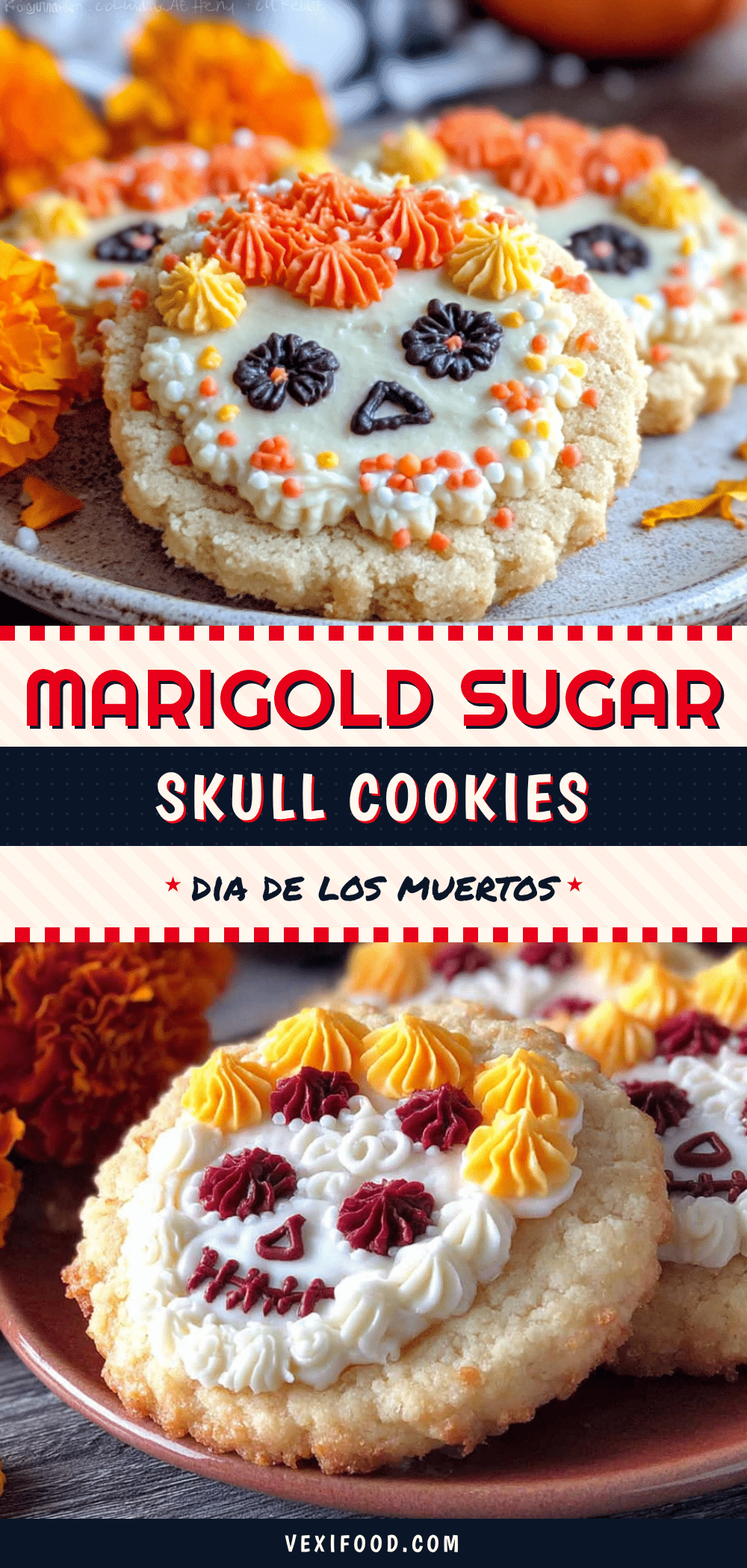
Lighter Marigold Sugar Skull Cookies for Day of the Dead

These lighter sugar skull cookies use Greek yogurt and dried marigold petals for a tender, floral-infused treat that honors Dia de los Muertos tradition without the heaviness. Perfect for ofrendas or celebrations, they feature crispy edges, soft centers, and a subtle honey-like warmth.
- Prep Time: 25 minutes
- Cook Time: 10 minutes
- Total Time: 45 minutes
- Yield: 20 cookies 1x
- Category: Dessert
- Cuisine: Mexican
Ingredients
- 2 ¼ cups (280g) all-purpose flour
- 1 teaspoon baking powder
- ¼ teaspoon fine sea salt
- 4 tablespoons (56g) unsalted butter, softened
- ½ cup (120g) full-fat Greek yogurt
- ¾ cup (150g) granulated sugar
- 1 large egg, room temperature
- 1 teaspoon pure vanilla extract
- ¼ teaspoon almond extract (optional)
- 2 tablespoons dried marigold petals, finely ground
- 2 cups (240g) powdered sugar, sifted
- 2 tablespoons meringue powder
- 3–4 tablespoons warm water
- ½ teaspoon vanilla extract
- Gel-based food coloring (orange, yellow, purple, pink)
- Edible marigold petals for garnish
Instructions
- Preheat your oven to 350°F (175°C). Line two baking sheets with parchment paper.
- Grind the dried marigold petals through a fine-mesh strainer to get about 1 tablespoon of fine powder. Set aside.
- In a medium bowl, whisk together the flour, baking powder, salt, and ground marigold powder until evenly distributed.
- In a large bowl, beat the softened butter and sugar together until light and fluffy, about 3 minutes. Scrape down the sides halfway through.
- Beat in the Greek yogurt, egg, vanilla, and almond extract until smooth. Do not overmix.
- Gradually add the dry ingredients to the wet mixture, mixing on low speed until a soft dough forms. Stop as soon as no streaks of flour remain.
- Lightly flour your work surface and rolling pin. Roll the dough to ¼-inch thickness.
- Use a skull cookie cutter to press out shapes. Re-roll scraps once. You should get about 18-20 cookies.
- Place cookies 2 inches apart on the prepared sheets. Bake for 8-10 minutes, rotating the pans halfway through. Edges should be just barely golden.
- Let cookies rest on the baking sheet for 5 minutes, then transfer to a wire rack to cool completely.
- For the icing: In a medium bowl, whisk together powdered sugar and meringue powder. Add 3 tablespoons warm water and vanilla extract. Beat on medium-high speed for 4 minutes until stiff peaks form. Add more water a teaspoon at a time if needed.
- Divide icing into small bowls and color as desired. Use piping bags to outline skull faces. While icing is still wet, press edible marigold petals into the design. Let decorated cookies sit for 2 hours to set completely.
Notes
Don’t overwork the dough to avoid tough cookies. Use room temperature ingredients. Rotate pans halfway through baking for even browning. For consistent thickness, use ¼-inch rolling guides. Let icing set fully before stacking cookies. Day-old cookies have more pronounced floral flavor.
Nutrition
- Serving Size: 1 cookie
- Calories: 130
- Sugar: 14
- Sodium: 60
- Fat: 4
- Saturated Fat: 2
- Carbohydrates: 22
- Fiber: 1
- Protein: 2
Keywords: sugar skull cookies, Day of the Dead, Dia de los Muertos, marigold cookies, lighter sugar cookies, Greek yogurt cookies, Mexican dessert, ofrenda cookies, skull cookies, holiday baking